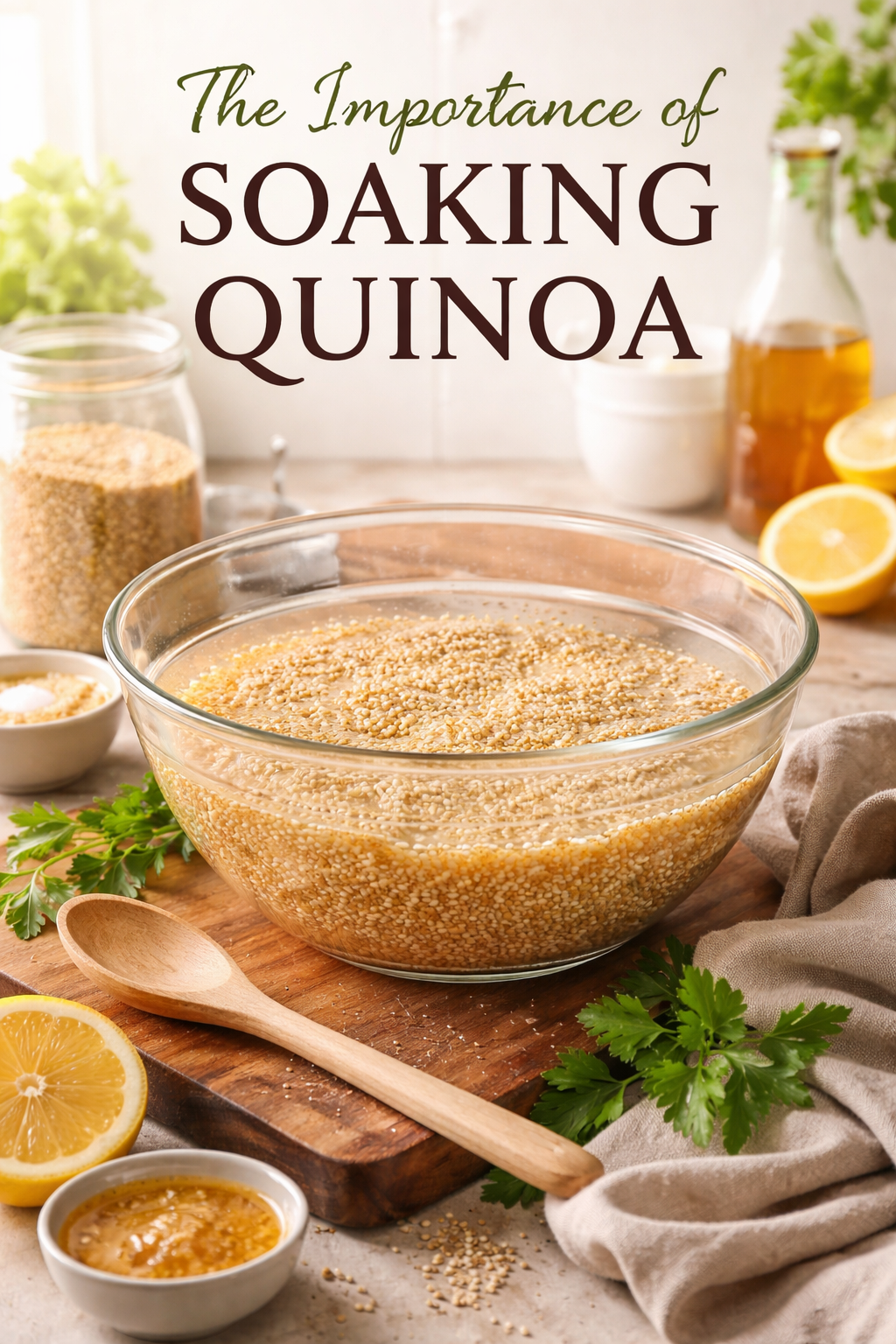
The Quiet Power of Soaking Quinoa
Why this Ancient Preparation Method Deserves a Place in the Modern Kitchen
In an era obsessed with superfoods and speed, the most transformative health practices are often the simplest—and the oldest.
Quinoa has earned its place in contemporary wellness culture. It is praised for its complete protein profile, mineral density, and gluten-free versatility. It appears in meal prep containers, upscale café bowls, and performance nutrition plans alike. But what few discuss is this: how quinoa is prepared may matter as much as the quinoa itself.
Before it became a trend, grain preparation was a ritual.
And soaking was non-negotiable.
A Small Step with Significant Biological Impact
Quinoa, though technically a seed, behaves like a grain. Like most grains and legumes, it contains natural defense compounds—most notably saponins and phytic acid.
Saponins coat the outer layer of quinoa. They create bitterness and can irritate sensitive digestive systems. Phytic acid, meanwhile, binds to minerals such as zinc, magnesium, iron, and calcium—reducing their absorption.
From a plant’s perspective, these compounds are protective. From a human metabolic perspective, they can be limiting.
Soaking initiates a quiet transformation:
It reduces residual saponins
It helps neutralize phytic acid
It activates enzymatic processes
It improves mineral bioavailability
It makes the grain lighter and easier to digest
This is not folklore. It is biochemistry.
What Our Grandmothers Understood
Traditional cultures did not consume grains casually. They soaked, sprouted, fermented, and slow-cooked them. These techniques were not culinary flourishes—they were protective strategies that respected both the food and the body.
Modern life has compressed preparation into minutes. But digestion has not evolved at the same pace as convenience.
When grains are rushed, the body often pays the price: bloating, mineral depletion, subtle inflammation, or digestive heaviness that we dismiss as “normal.”
It is not normal. It is common.
There is a difference.
The Mineral Conversation We’re Not Having
Many women today struggle with low iron, suboptimal zinc, and magnesium depletion—minerals foundational to hormone balance, thyroid conversion, mood stability, and energy production.
If quinoa is being consumed regularly for its nutrient density, yet prepared without soaking, we may be undermining the very benefits we seek.
For those rebuilding metabolic health, supporting menstrual regularity, or recovering from inflammatory patterns, soaking is not an optional refinement. It is a strategic adjustment.
Preparation determines absorption.
A Return to Rhythm
Soaking quinoa overnight does something subtle but powerful. It restores a sense of rhythm to the kitchen. It shifts us from reactive cooking to intentional nourishment.
The act itself is unremarkable: rinse, cover with water, wait. But in that waiting, something changes—not only within the grain, but within us.
We begin to approach food with respect.
And respect, in nutrition, often translates to resilience in the body.
Is It Always Necessary?
For individuals with robust digestion and no mineral concerns, thorough rinsing may suffice. The body is adaptable.
But for those healing the gut, recalibrating hormones, or optimizing nutrient absorption, soaking is a low-effort, high-impact upgrade.
There is elegance in doing things properly.
Not because it is trendy.
Not because it is extreme.
But because it works.
The Larger Lesson
Wellness is rarely built from dramatic gestures. It is built from foundational practices repeated consistently.
Soaking quinoa will not make headlines. It will not go viral. But it reflects a broader principle worth reclaiming: thoughtful preparation enhances biological harmony.
In a culture that rushes everything, perhaps true luxury is slowing down long enough to prepare food the way it was always meant to be prepared.
Sometimes, the path forward is found in looking back.
By: Tania Facussé
Founder of DESIGN 2 ORGANIZE & Co. LLC & Organica Living™ | Holistic Design & Lifestyle Consultant